
Carry-On Rules Are Changing in 2026 x Is Your Backpack Still Compliant?
The rule hasn’t changed. The enforcement has.
For years, the standard US carry-on limit has been 22 x 14 x 9 inches, measured including wheels, handles, and anything else sticking out of the bag. That number isn’t new. What’s new in 2026 is who’s checking it, and how.
United has installed automated bag scanners at more than 35 airports, with plans to expand past 80 by the end of the year. American and Delta are running their own pilot programs at major hubs. These systems use cameras to measure a bag’s exterior dimensions as it moves through the boarding lane, and they flag anything oversized before it reaches the gate agent. There’s no judgment call, no “looks close enough,” no being waved through because the line is long and the flight is full.
That shift matters for one simple reason: a bag that’s passed every flight you’ve taken for the last three years might not pass your next one.

Carry-On Rules Are Changing in 2026 x Is Your Backpack Still Compliant?

Larry Sanger
Don’t let your past years be your best years, better life now, best life coming. Explore the world. Learn everyday. Happy travels!
Planning your next trip?
What Actually Changed
Three things, specifically.
Measurement is now automated, not visual. Gate agents used to eyeball a bag or do a quick test-fit in a metal sizer. Automated scanners measure the full exterior – body, wheels, handle, any pocket that protrudes outward and compare it against the limit with no room for interpretation.
Enforcement is tied to operational metrics. Several airlines have linked carry-on enforcement to on-time departure performance. A gate that’s slow to board because of oversized bags being sorted out at the last minute is now a tracked problem, which means agents have more incentive to catch noncompliant bags early rather than wave them through.
Soft-sided bags lost their old advantage. Compressible bags used to get some leeway because they could be squeezed into a sizer by hand. Automated systems measure the bag at its actual packed size, not its squeezed-down size, which removes that workaround entirely.
The result: bags that are marketed as “carry-on compliant” but run slightly over the limit once fully packed, which describes a large share of bags on the market are now getting caught at a rate they never were before.
How to Check Your Own Bag
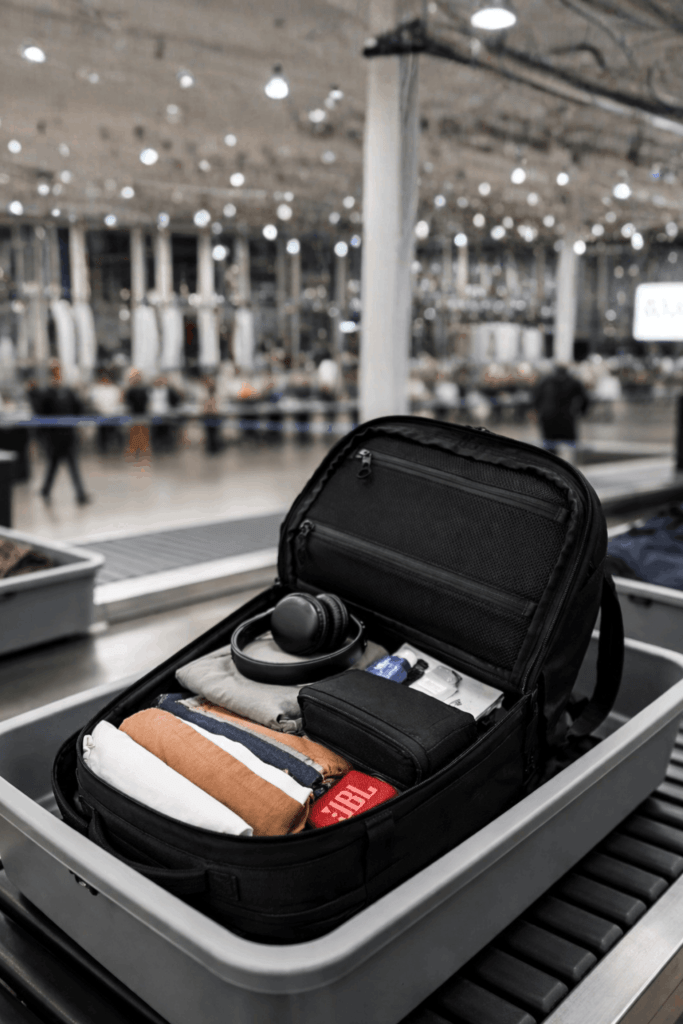
Before your next trip, do this at home rather than finding out at the gate:
- Pack the bag the way you actually travel with it. A bag measured empty tells you nothing. Pack it full, including anything that goes in exterior pockets.
- Close every expansion zipper. If the bag has one, measure it closed. Airlines measure the bag in its standard configuration, not its expanded one.
- Measure the full exterior with a tape measure. Top of the handle in its stowed position to the bottom of the wheels. Widest point including side pockets. Front-to-back depth at the fullest point.
- Compare against your specific airline, not the general standard. Southwest’s limit is larger than the rest. Budget carriers are smaller. Check before you book a fare that doesn’t include a free carry-on at all.
If the bag is within a quarter-inch of the limit when packed, treat it as noncompliant. A scanner doesn’t round in your favor.
Why Backpacks Have an Advantage Right Now
Roller bags have a structural problem under this kind of enforcement: wheels and a telescoping handle add fixed height that can’t be compressed, and that height is exactly what scanners measure. A hardshell roller marketed at “22 inches” can measure 23.5 inches once the handle and wheels are accounted for, enough to fail a scanner that wouldn’t have failed a gate agent’s eye test two years ago.
A well-built backpack doesn’t carry that same structural penalty. There’s no telescoping handle adding fixed height, no wheel assembly extending the base. The dimensions on the label are closer to the dimensions a scanner actually measures, which is the difference between a bag that’s compliant on paper and a bag that’s compliant at the gate.
This is the specific problem the Roy G 35L was built around. It’s sized to standard carry-on dimensions with no expansion zippers that change its profile when packed, and it carries 22 separate compartments so the organization that used to require a second bag, or a larger one, fits inside the same footprint. It comes with a lifetime warranty, which matters more under stricter enforcement, not less: a bag that gets handled by gate agents and shoved into bins more aggressively needs to hold up to that handling for years, not one trip.
The Takeaway
Nothing about the size limit itself changed in 2026. What changed is that airlines finally have the tools to enforce a rule that’s existed for years, and the old margin for error, a sympathetic agent, a slow line, a bag that “always fit”, is gone. The fix isn’t complicated: measure your bag packed, check it against your airline’s real limit, and choose one that’s built to the standard rather than marketed to it.
Carry-On Rules Are Changing in 2026 x Is Your Backpack Still Compliant?
A Trusted Companion for Years to Come
If you are looking for the best carry on backpack for business travel, look for something that respects your time and routine. A bag should not be another problem to manage. It should be a reliable tool that makes each trip smoother than the last.
When your gear is sorted, you arrive sharper. And in business travel, that edge matters.
Planning your next trip?
If you are planning to get a water resistant backpack, check out Regnas Backpacks in this blog, Choosing the Perfect Travel Backpack>>
Follow REGNAS on Instagram: @regnas.backpacks
Follow REGNAS on Facebook: @regnas.backpacks